
During his lifetime, CH Spurgeon’s printed sermons sold as many as 25,000 copies each week and were translated into more than 20 languages. His popularity endures today, as many untold thousands continue to read his sermons. But what was it like to actually be one of the thousands of people who walked through the doors of the Metropolitan Tabernacle on a Sunday morning?
Thanks to a handful of vivid firsthand accounts left by visitors and recorded by biographers, we have a surprisingly detailed picture of what services were like at Spurgeon’s church.
In the video below, we will hear detailed accounts from several people who visited Spurgeon’s church for both Sunday morning and Sunday evening services. In them you will get a clear picture of what it was like to go and hear a sermon from the Prince of Preachers. ⬇️
The Scale of the Tabernacle
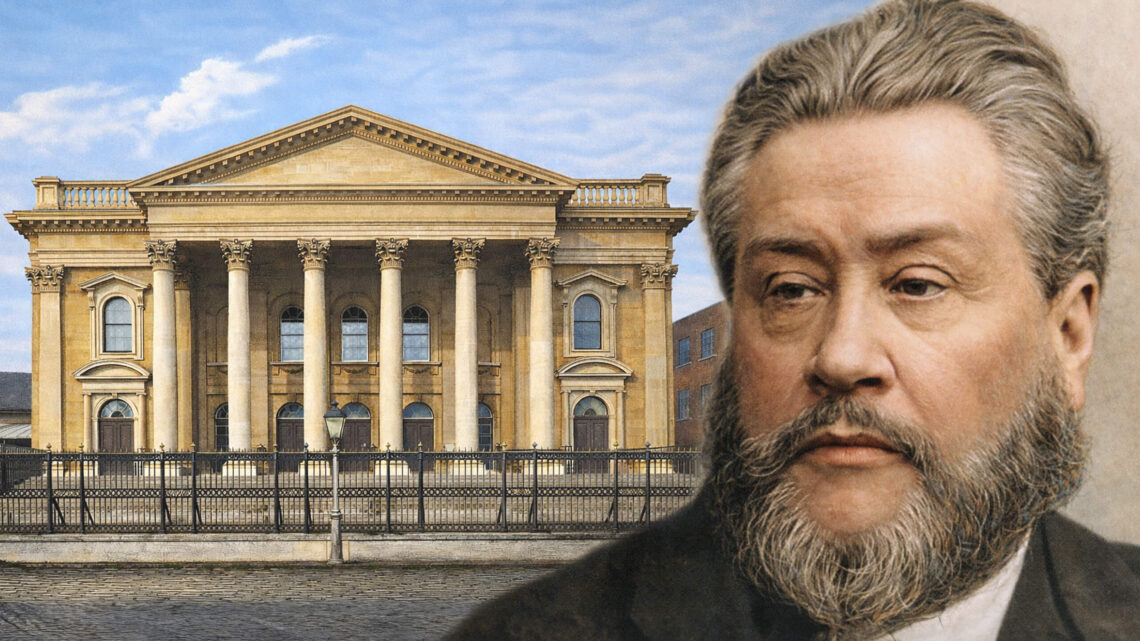
Opened in 1861, the Metropolitan Tabernacle seated around 6,000 people, and it was routinely full for both the morning and evening services. While the scale was massive, some commented that “the building has very little of the church appearance, and a stranger would be more likely to take it for a law court, or commercial building, than for a house of worship. It is an immense square structure, with entrance at both ends and on each side. The exterior of the building presents nothing very attractive to the eye, except in its magnificent facade.”
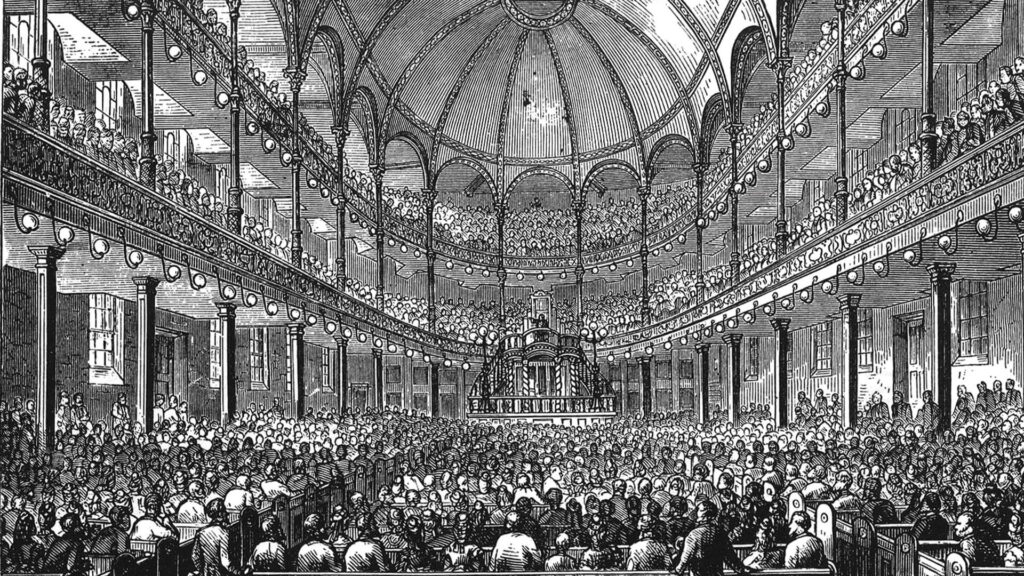
The interior was deliberately plain and unadorned. Perhaps surprisingly, Spurgeon did not use a traditional pulpit. “Mr. Spurgeon has no pulpit. He simply occupies a little spot in the heel of the first gallery; from which place he has as good a command of his congregation as it is possible to have in so large a house. His congregation is above, below, and all around him. The seats on the main floor are in amphitheater style; so also are the galleries.”
The Singing
One of the most frequently remarked-upon features of a Tabernacle service wasn’t Spurgeon’s preaching — it was the congregational singing. With no choir and no organ leading worship, thousands of voices filled the building together. According to one observer, the singing “and seemed to lift the people on angels’ pinions up to the third heavens.”
Spurgeon himself compiled a hymnal of over 1,100 hymns for the congregation’s use called Our Own Hymn Book, and congregational participation in singing was treated as genuine worship, not performance. Spurgeon even wrote a number of hymns himself!
Opening prayer, followed by a hymn. Reading of Scripture, running commentary of the passage that was read. Another hymn and a prayer, and then the sermon. A typical sermon lasted between 45 minutes to an hour. Then a final hymn and a prayer.
The Order of Service
A Sunday morning service at the Metropolitan Tabernacle followed a simple, unhurried order rooted entirely in Scripture and prayer. The service opened with prayer, followed by a congregational hymn. A portion of Scripture was read, with Spurgeon providing a running commentary. After this, the congregation sang another hymn and Spurgeon led them in prayer. Then came the sermon, which typically ran between 45 minutes to an hour. Despite the massive size of the crowd and the lack of electronic amplification, the crowd of thousands could hear him well.
As we hear from one visitor: “Those who sit close to the preacher’s table will, perhaps, have observed that his tones of voice apparently adapt themselves to the circumstances of those who are near as well as to those who are farther away. To persons near at hand they are not unpleasantly loud, while to those in the distance they are loud enough – not that the vast concourse are made to hear without an effort, even by the most powerful lungs, but the necessary strain is visible only to those who are in proximity to the preacher.”
After the sermon was complete, there was a final hymn and prayer. The entire service was structured to focus on worshipping God and hearing His Word and (to the disdain of the stuffy ministers of London in the Victorian era) was free from all the pomp and circumstance of typical church services. Spurgeon’s primary focus was on pointing his hearer to Christ, and he did not want anything included in the service that might detract from this purpose.

For a more detailed look at what a Sunday with Spurgeon was like, watch the video at the top of the page. You’ll hear firsthand accounts from those who attended, as well as a great number of photos to help you get a sense for the Metropolitan Tabernacle in Spurgeon’s day.
Whether you’re a longtime student of Spurgeon or just beginning to explore his legacy, these eyewitness descriptions offer a remarkable window into Victorian Baptist worship at its height — and a challenging vision of what the gathered church can be.